In today's fast-paced business environment, implementing automation solutions can be a game-changer. Many companies seek ways to enhance efficiency and reduce manual tasks. Automation solutions help streamline processes, enabling teams to focus on what truly matters.
Embracing automation is not without its challenges. Choosing the right tools can be overwhelming. Some businesses may struggle to integrate automation smoothly into their existing workflows. These hurdles may lead to frustration or resistance from employees. Understanding your team's needs is crucial before making a decision.
Successful implementation requires careful planning. Start by analyzing current operations to identify areas where automation can provide support. Test different solutions to find the best fit. Remember, as automation solutions become a part of your daily operations, continuous improvement is essential. Adapting to changing circumstances will ensure your business stays competitive.

Automation is reshaping the business landscape. Companies embracing automation witness significant improvements. According to a recent study, organizations can see up to a 30% increase in productivity. Yet, many struggle to adopt these technologies fully. It’s not just about software; it’s about culture.
The benefits of automation go beyond efficiency. Businesses can enhance customer satisfaction and reduce error rates. A report by industry analysts indicates automated processes can decrease human errors by up to 50%. However, the transition is often challenging. Employees may resist change, fearing job losses. Leaders must address these fears to ensure successful integration.
Data also reveals that around 40% of automation initiatives fail due to poor planning. Companies should not underestimate the importance of training and support. Investing in employee development is crucial. While automation offers great potential, careful implementation is necessary. Balancing technology with human resources is vital for sustainable growth.
| Automation Solution | Description | Benefits | Estimated Cost |
|---|---|---|---|
| Email Marketing Automation | Automates sending emails to customers based on their behavior and preferences. | Increased customer engagement, saving time, personalized communication. | $200 - $500/month |
| CRM Automation | Streamlines customer relationship management processes. | Improved customer insights, enhanced sales tracking, efficient follow-ups. | $300 - $1000/month |
| Social Media Automation | Automates posting and scheduling content on social media platforms. | Consistent posting, broader reach, analytics tracking. | $100 - $300/month |
| Accounting Automation | Automates invoicing, expense tracking, and financial reporting. | Reduced errors, time savings, real-time financial overview. | $200 - $800/month |
| Inventory Management Automation | Automates stock tracking, ordering, and inventory levels. | Better stock control, reduced costs, improved order accuracy. | $150 - $600/month |

Identifying key areas in your business for automation is crucial. Start by assessing repetitive tasks that consume time. For instance, think about invoicing, customer queries, or inventory management. These are basic but often overlooked. Automating these processes can free up hours weekly.
Tips: Look for tasks your team dreads. If a task feels tedious, it’s a candidate for automation. Talk to your employees about their daily challenges. They might point out inefficiencies you haven’t noticed. Their insights are valuable.
Another area for automation is data management. Think about how much time is spent entering data manually. Errors often occur during this process. Implementing automation can reduce mistakes and increase accuracy. Consider integrating software that collects and organizes data efficiently.
Tips: Regularly review automated processes. If they aren’t providing value, rethink your approach. Monitor results closely. Reflect on what's working and what's not. Continuous improvement is key in automation. Focus on the areas that make a real impact on your business growth.
When selecting the right automation tools for your business, clarity is key. Start by identifying your specific needs. According to recent studies, 70% of organizations that customize their automation tools see significant improvements in efficiency. Assess different departments to see where automation can help most.
Next, look for tools that offer flexibility and integration capabilities. A report by an industry analyst highlighted that businesses lose 20% of productivity when tools don't integrate well. Therefore, investing in solutions that play nicely with existing systems can yield better results.
Don’t overlook user experience. Tools that are difficult to use create frustration. A survey indicated that 40% of employees resist using automation due to usability concerns. Focus on platforms that offer intuitive interfaces. Reflecting on past choices can also guide you. Analyze which previous tools fell short and understand why. This can inform smarter decisions moving forward.
Implementing automation solutions can seem daunting. Start by identifying repetitive tasks in your business. Look for areas where efficiency can be improved. Common tasks might include data entry, customer responses, or inventory management. Ask your team for input. Their insights can highlight overlooked opportunities.
Once you've pinpointed tasks, define your goals clearly. What do you hope to achieve? Is it time savings or improved accuracy? Documenting these objectives will guide your decisions. Not every automation tool is suitable for every task. You may find that what works for one department might not fit another.
Testing is crucial in this process. Begin with small-scale implementations. Monitor performance closely. Make adjustments based on real-time feedback. This iterative approach may reveal flaws you didn’t anticipate. Sometimes, the tools you choose may not integrate well with existing systems. Acknowledge and reflect on these challenges as part of your learning curve.
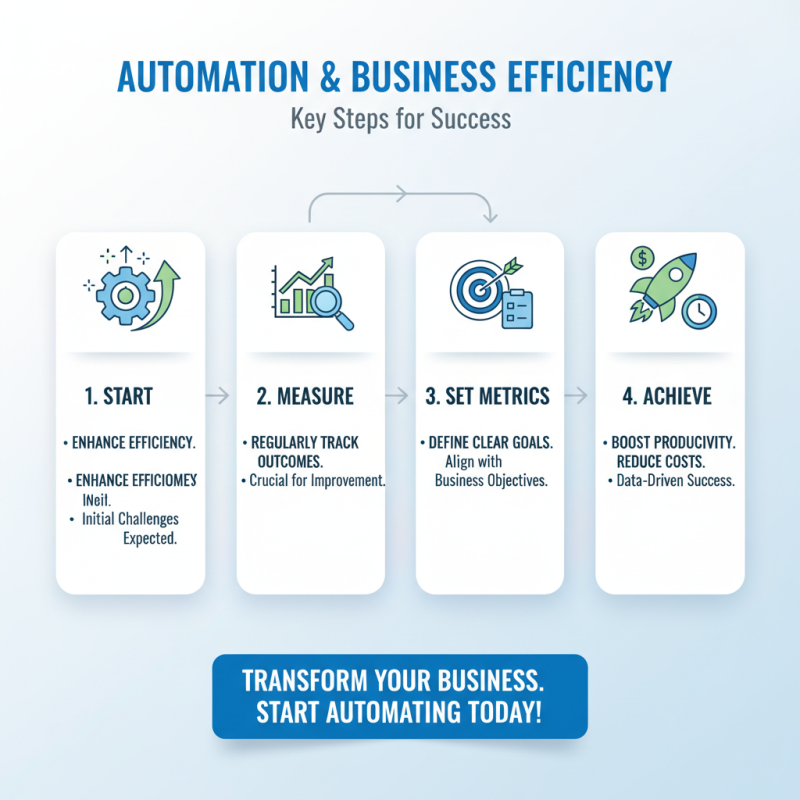
Automation can significantly enhance business efficiency. However, success isn't guaranteed from the start. Regularly measuring outcomes is crucial. It’s important to set clear metrics. These metrics should align with your overall goals. Maybe you want to boost productivity or reduce costs. By defining these, you establish a baseline to track improvements.
Monitoring the effectiveness of automation is vital. Gather data consistently to see where adjustments are necessary. If a system isn’t generating expected results, it may need tweaking. Sometimes, the technology may not fit the task as anticipated. In such cases, consider revising your approach. Flexibility is key. This is about learning and improving, not just implementing solutions.
Feedback from your team is also essential. They interact with these systems daily. Their insights can highlight issues you might overlook. This input can guide successful adjustments. Remember, automation is not a one-time fix. It requires ongoing evaluation and refinement. Adaptation is the path to sustained success.